
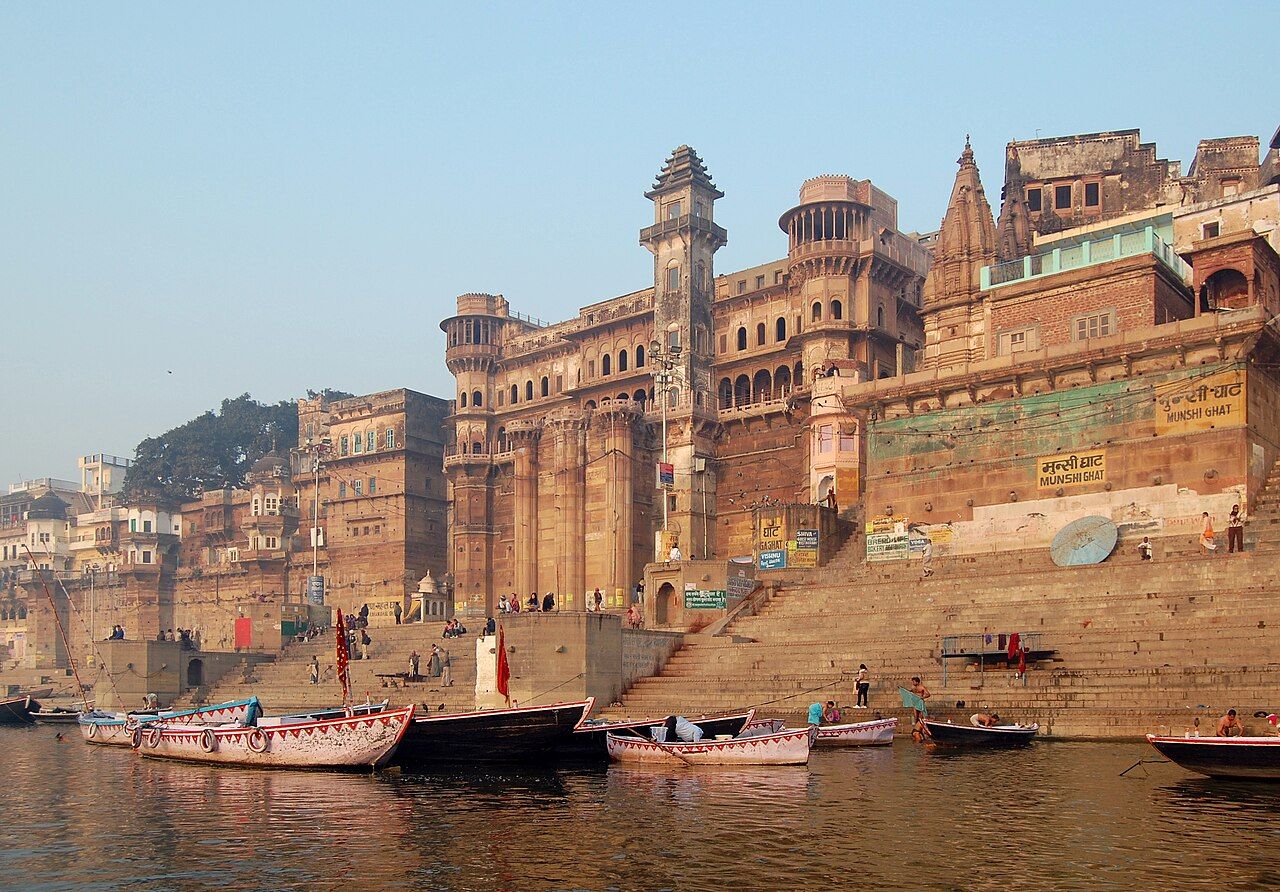
Varanasi, also called Kashi and Banaras, is one of the holiest cities in Hinduism and among the oldest continuously inhabited cities anywhere. Its old town is built along the western bank of the Ganges, where more than eighty ghats, broad flights of stone steps, run down to the water. Pilgrims come to bathe, families come to cremate their dead, and the rest of the city comes to wash clothes, play cricket, sell flowers and talk.
The first hours can be overwhelming: crowds, cows, motorbikes in alleys barely wider than your shoulders. Give it a day and it starts to make sense. The river is the organising fact, and the best way to understand the city is to see it from the water at dawn.
A boat at sunrise
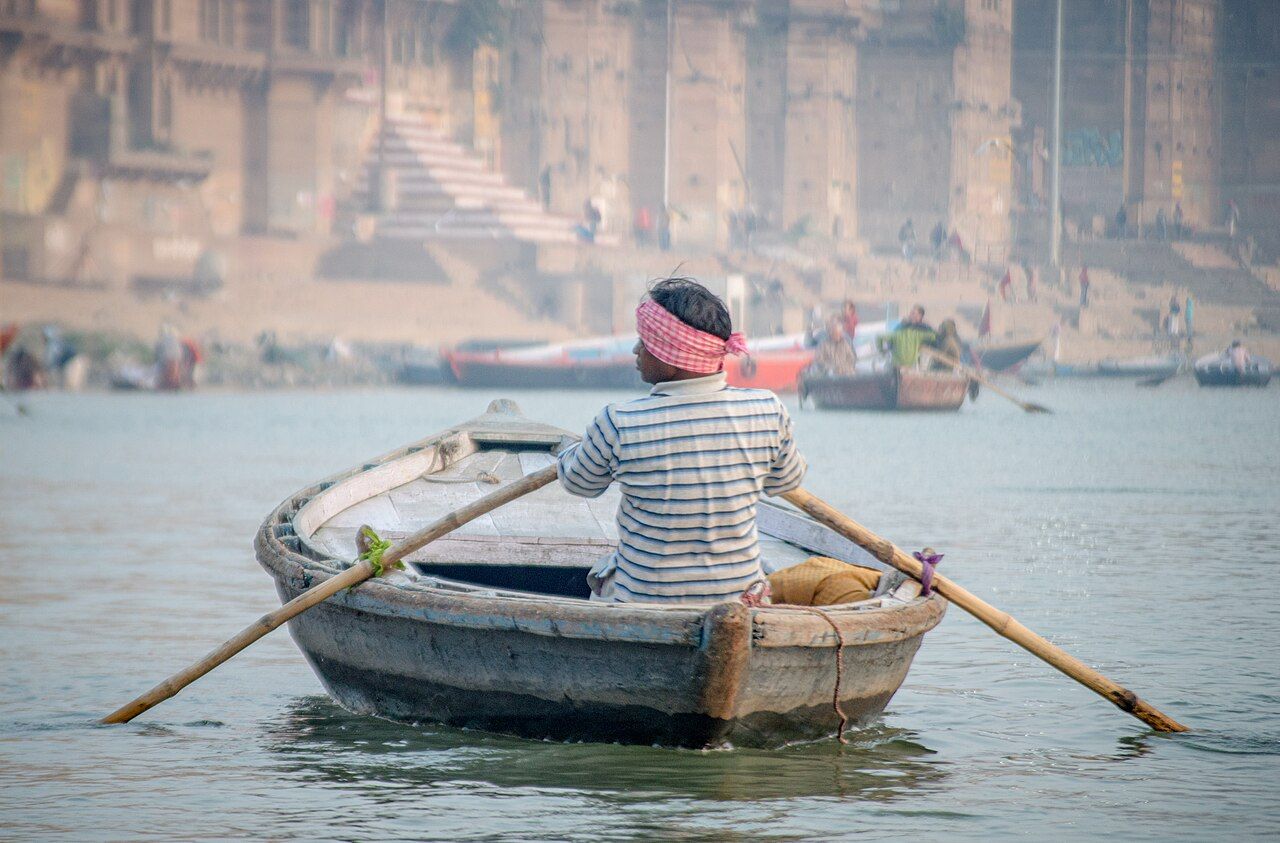
Before sunrise the ghats are already busy with bathers, and boatmen wait at the foot of the main steps. A rowing boat is slower and quieter than a motor launch and lets you drift past the ghats as the light comes up behind you from the empty eastern bank. An hour is enough to see a long stretch of the waterfront, from temples and old palaces to laundry spread out to dry on the steps.
Agree the price, the length of the trip and which way you will go before you step in, and pay at the end. Sit low and still; the boats are narrow. During the monsoon, roughly July to September, the river rises over the lower steps and boating can be suspended.
credit
Philip Nalangan · CC BY 4.0The cremation ghats
Manikarnika Ghat and Harishchandra Ghat are the cremation grounds, where pyres burn through the day and night. Many Hindus believe that being cremated in Varanasi frees the soul from the cycle of rebirth, and families travel great distances to bring their dead here. It is a working place of grief and ritual, not a spectacle.
You may watch from a respectful distance, ideally from a boat or from the steps above. Do not photograph or film the cremations, the bodies or the mourners. Dress modestly and keep your voice low. Men sometimes approach visitors at Manikarnika claiming to work for a hospice and asking for money for wood; decline politely and move away. Nobody needs to guide you here, and you do not need to stay long to understand what you are seeing.
The evening aarti
Every evening at dusk, priests at Dashashwamedh Ghat perform the Ganga aarti, a choreographed offering to the river with large brass lamps, bells, conch shells, incense and chanting. It draws big crowds of pilgrims and visitors alike. Arrive well before sunset to find a place on the steps, or watch from a boat, where dozens of craft pull in close to the ghat. Pickpockets work the crush, so keep your bag in front of you.
A smaller, calmer ceremony takes place at Assi Ghat, at the southern end of the waterfront, early in the morning. If crowds wear you down, it is the gentler introduction.
 Next on the tag · AsiaKerala's backwaters by public ferry
Walking the ghats and the lanes
Walking the riverfront from Assi Ghat northwards takes a few unhurried hours with stops. Each ghat has its own temples, its own palaces built by princely families from across India, and its own character: some are crowded with bathers, others are quiet places where people sit and watch the water. In the dry season you can walk most of the way along the steps without leaving the river.
Behind the ghats runs the old city, a maze of narrow lanes lined with shrines, sweet shops, silk weavers and houses. You will get lost, and that is fine; the river is always downhill, and a turn towards it brings you back to the steps. An offline map helps more than directions from strangers, some of whom will lead you to a shop.
The Kashi Vishwanath Temple, one of the most important temples to Shiva, sits in the old city. Security is strict, and phones, bags and other items are usually not allowed inside; lockers are available nearby.
Sarnath, a quiet half-day
Sarnath, around 10 kilometres from the old city, is where the Buddha is believed to have given his first sermon after his enlightenment. The site is a calm park of brick monastery ruins around the great Dhamek Stupa, with temples built by Buddhist communities from several countries nearby. The site museum holds the Lion Capital of Ashoka, the sculpture that became the national emblem of India.
After the lanes of Varanasi, Sarnath's lawns and trees feel like a deep breath. Go by taxi or auto-rickshaw and agree the fare and waiting time before you leave.
Seasons, getting there and eating
The cool months from November to February are the most comfortable, with mild days and cold, often foggy mornings; in December and January the fog can delay trains and flights for hours. From April to June the heat is severe. Major festivals bring huge crowds.
Overnight trains from Delhi are the classic way in, and they can run very late, so leave slack in your plans; the advice on missed connections is worth reading first. Flights also serve the city's airport. If Varanasi is one stop on a longer route through India, the forts and observatory of Jaipur make a good contrast.
Eating vegetarian is easy. Much of the old city is vegetarian by custom, especially near the temples, and breakfast of fried kachori with spiced potatoes and a glass of thick lassi is a local habit. Ghee and dairy are common, so vegans should ask.